
Customer discovery questions for your ICP
Choose one assumption, ask about a recent event, and record what supports or contradicts it. Keep AI rehearsal separate from real interviews.
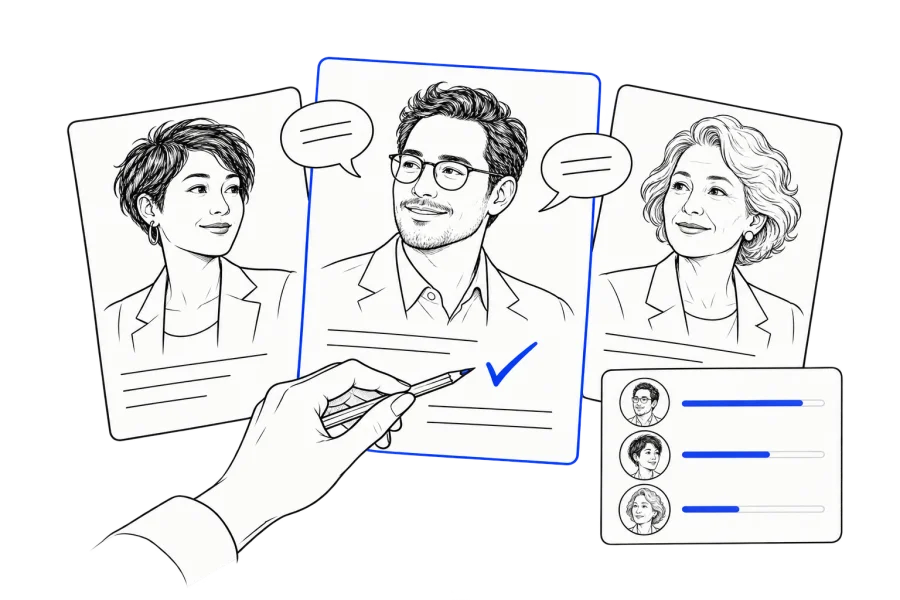
The list gives you who. The calls give you why.
You already pay for name lists. They hand you a title, a company size, a country. They cannot tell you what broke the buyer's week, what they use today, or who else signs off. Deals stall in that gap.
An ICP drafted from a product description is a hypothesis. Real conversations and permitted artifacts can help you check individual statements before you use them in outreach. They do not automatically establish market demand.
Three things a list cannot answer
- Trigger
- What changed for them in the last month.
- Alternative
- What they use instead of you right now.
- Blocker
- Who else has to agree before money moves.
How to interview the real buyers
Start with the uncertainty that could change your decision, then ask about what actually happened.
Ask
- Cover roles and situations that could change the decision, including people who do the task and people who approve a change.
- Ask about the last time it happened: “Walk me through the last time this came up.” Record the account as reported, and future intentions as unverified.
- What they did before you existed. The workaround they describe is the baseline you actually compete with.
- Who else was in the room when they signed. That names the approver your list keeps missing.
- Ask whether there is an artifact they are allowed to share. Record only the evidence you have permission to use.
Do not ask
- Avoid “Would you buy this?” before understanding a recent event. A positive answer alone does not validate demand.
- Leave room to understand the event before pitching. An interview is not a demo; no fixed number of minutes makes it valid.
- Hypotheticals. “If we built X” gets you an answer about a product that does not exist.
A customer discovery script you can adapt
Pick one assumption to check before the call. For example: “Teams add another warehouse before their stock spreadsheet stops working.” This is a hypothesis from an illustrative inventory-software scenario, not a finding.
This sequence is a suggested planning format, not a validated interview method or a required duration. Leave room for an unexpected answer.
| Part of the conversation | Ask | What to record |
|---|---|---|
| Set context | “What are you responsible for in this process?” | Their role and the task they actually own. |
| Reconstruct a recent event | “Walk me through the last time stock counts did not agree. What happened first?” | A specific event, its sequence and when it happened. If it never happened, record that. |
| Find the existing alternative | “What did you use to sort it out?” | Tools, people and workarounds used at the time. |
| Find the costly or difficult step | “Which part needed the most attention? Can you show an example you are allowed to share?” | The participant’s description and any permitted artifact. Do not turn a guess into a measured cost. |
| Understand the decision | “When you last changed this process, who had to agree?” | Sponsor, user, approver and blocker, if those roles existed. |
| Seek disconfirmation | “When does the current process work well enough? What would make changing it unnecessary?” | A reason your product or proposed ICP may be wrong. |
| Close with a next check | “What have I misunderstood? Is there another role whose experience is different?” | Corrections, missing roles and a next check. |
For another product, replace the stock-count event with its actual task. Avoid “Would you buy our solution?” until you understand what happened without it.
Copy an evidence note after the call
Profile assumption being checked:
Participant role and relevant context:
Conversation date:
Recent event discussed:
Their words, only if permission allows quotation:
Artifact checked, if permitted:
What supports the assumption:
What contradicts it:
What remains unknown:
Decision: keep / narrow / revise / test a different assumption
Next check and owner:
Use reported for an account of an event and observed only for something you actually inspected or watched. A confident answer does not turn an estimate into a measured saving. A single call can change your draft; it cannot establish how common the problem is in a market.
Choose interviews by the uncertainty you need to resolve
Cover the roles and situations that could change the decision. Start with a small set you can arrange, then record what you still do not know. Repeated answers are useful context, not an automatic stopping rule or proof that the sample represents the market. Different answers may reflect different segments, roles or experiences.
If you cannot reach the people who do the task, keep the finding unverified. Do not fill the gap with simulated answers and call it customer validation.
Use AI rehearsal to improve the questions
An AI persona can help you spot a leading question or a missing follow-up. Its responses are simulated material, not customer evidence.
Keep rehearsal notes separate from notes from real people. Never count an AI answer as an interview, a quotation or evidence of willingness to pay.
The public ICP generator can be a starting point for assumptions to check. Signed-in persona chat and contact matching are separate features; check availability and plan limits in your account.
Start with an assumption you can check
Draft assumptions, choose the people whose experience could change them, and prepare questions about real events.
AI rehearsal prepares questions. Real conversations and permitted observations supply evidence; neither a copy click nor a simulated reply completes a real interview.